Friday, March 23, 2012


Wednesday, March 21, 2012


ndonesia concrete balls combat 'train surfing'

Workers erect the concrete balls to deter 'train surfers'
Railway
staff in Indonesia have started hanging concrete balls above train
tracks to try to prevent commuters from riding on carriage roofs.
The first balls were installed just above carriage-height near a station outside the capital, Jakarta. More will be put up elsewhere if they are found to keep people off the roofs.
Previous attempts to deter roof riders included spraying roofs with paint, spreading oil on carriages and hiring musicians to perform safety songs.
Correspondents say those initiatives have failed. Officials hope that the latest move will prove to be the ultimate deterrent.
Roof riders also face the possibility of imprisonment.
Electrocuted The balls - which can deliver a severe blow to the head - will be suspended a few inches above the tops of carriages at points where trains enter or pull out of stations, or where they go through crossings.
 Critics say that 'roof surfing' takes places because there are not enough trains
Most victims are electrocuted by overhead power cables, but some fall off train carriages while trains are moving.
The BBC's Dewi Safitri in Jakarta says that passengers on train roofs can be seen every morning and evening. At peak times about 400,000 commuters cram in or onto carriages to travel into and out of the centre of Jakarta.
While tickets are cheap by Western standards, poorer people struggle to pay which is why they go on the roofs, correspondents say.
The main problem, commuters say, is just how crowded the trains are. Reports say some ticket holders also end up on train roofs because there is no room inside.
Officials say they have tried everything to stop the problem - and even put rolls of barbed wire on train roofs - but nothing has worked.
Officials say that if the latest initiative is successful, the project will be expanded.
But the "roof surfers" themselves told the Associated Press news agency that they are determined not to be put off.
"I was really scared when I first heard about these balls,'' said Mulyanto, 27, who rides daily between his hometown of Bogor and Jakarta almost every day for work.
"It sounds like it could be really dangerous. But I don't think it will last long. They have tried everything to keep us from riding... but in the end we always win.''
Indonesian trains run on often poorly maintained tracks left behind by Dutch colonisers 60 years ago.
Critics say that the problem of "roof surfing" will never be completely ironed out until there are fewer delays and enough trains to meet demand.
Indonesia profile

Spread across a chain of thousands of islands between Asia and Australia, Indonesia has the world's largest Muslim population.
Ethnically it is highly diverse, with more than 300 local
languages. The people range from rural hunter-gatherers to a modern
urban elite. Indonesia has seen great turmoil in recent years, having faced the Asian financial crisis, the fall of President Suharto after 32 years in office, the first free elections since the 1960s, the loss of East Timor, independence demands from restive provinces, bloody ethnic and religious conflict and a devastating tsunami.
Sophisticated kingdoms existed before the arrival of the Dutch, who consolidated their hold over two centuries, eventually uniting the archipelago in around 1900.
After Japan's wartime occupation ended, independence was proclaimed in 1945 by Sukarno, the independence movement's leader. The Dutch transferred sovereignty in 1949 after an armed struggle.
 There is great ethnic diversity across Indonesia's many islands
But his policy of allowing army involvement in all levels of government, down to village level, fostered corruption. His "transmigration" programmes - which moved large numbers of landless farmers from Java to other parts of the country - fanned ethnic conflict.
Suharto fell from power after riots in 1998 and escaped efforts to bring him to justice for decades of dictatorship.
Post-Suharto Indonesia has made the transition to democracy. Power has been devolved away from the central government and the first direct presidential elections were held in 2004.
But the country faces demands for independence in several provinces, where secessionists have been encouraged by East Timor's 1999 success in breaking away after a traumatic 25 years of occupation.
 Indonesia has the world's largest Muslim population
Lying near the intersection of shifting tectonic plates, Indonesia is prone to earthquakes and volcanic eruptions. A powerful undersea quake in late 2004 sent massive waves crashing into coastal areas of Sumatra, and into coastal communities across south and east Asia. The disaster left more than 220,000 Indonesians dead or missing.
Tuesday, March 20, 2012
Sewu
| Sewu Temple Compound (Manjusrigrha) | |
|---|---|
 The Sewu temple compound |
|


Location within Java Topography
|
|
| General information | |
| Architectural style | Buddhist candi |
| Town or city | near Yogyakarta (city), Yogyakarta |
| Country | Indonesia |
| Coordinates | 7.7435°S 110.4935°E |
| Completed | circa 8th century |
| Design and construction | |
| Client | Sailendra or Mataram Kingdom |

History

Sewu main temple before reconstruction.
The temple was severely damaged during the earthquake in Java in 2006. The structural damage is significant and the central temple suffered the worst. Large pieces of debris were scattered over the ground and cracks between stone blocks were detected. To prevent the central temple from collapse, the metal frame structures were erected on four corners and attached to support the main temple. Although some weeks later in 2006 the site were re-opened for visitors, the whole part of main temple remains off-limits for safety reasons.
The temple complex

Aerial view of Sewu temple complex shows Mandala pattern

The images of Boddhisattva on wall of perwara temple
Along the north-south and east-west central axis at a distance of about 200 meter, between 2nd and 3rd row of smaller temple are located the penjuru (main directions) or perwara utama (main vanguard) temples, a couple on each cardinal points facing each other. The perwara utama temples are the second largest ones after the main temple, however only eastern twin perwara utama and a northern one still remains today. These smaller temples encompass a larger sanctuary that has been heavily looted.
Behind the 4th row of smaller temples lies the stone paved courtyard where the main temple stood on the center.
The main temple

The central chamber can be reached from the eastern room. The central chamber is larger than other rooms with a higher roof. Now all the five rooms are empty.. However the lotus carved stone padestal in central chamber suggested that the temple once contains a large bronze Buddhist statue (possible the bronze statue of Manjusri), probably reaching 4 meters tall. Now the statue is missing, probably being looted for scrap metal over centuries. However another theory suggested that the main statue was probably constructed from several stone blocks coated with vajralepa plaster.
Rara Jonggrang (legend)
|
|


The Story
The legend tells the story about two ancient and neighbouring kingdoms in Java, Pengging and Boko.Pengging was prosperous, and wisely ruled by its king Prabu Damar Moyo who had a son named Bandung Bondowoso. By contrast, Boko was ruled by a cruel man-eating giant named Prabu Boko, supported by another giant Patih Gupolo. Despite his unpleasant nature, Prabu Boko had a beautiful daughter named Rara Jonggrang.
The story relates that Prabu Boko desired to expand his kingdom, and so began training an army and raising taxes for an invasion of Pengging. His forces launch a surprise attack on Pengging, and the ensuring war causes devastation and famine on both sides. In order to defeat the invader, Prabu Damar Moyo sends his son Bandung Bondowoso to fight Prabu Boko. After a furious battle, Prabu Boko is killed by the prince's supernatural powers. His assistant, the giant Patih Gupolo, leads his armies away from the battlefield in defeat.
Returning to Boko Palace, Patih Gupolo tells princess Rara Jonggrang of the death of her father. The princess is heartbroken, but before she can recover from her grief the Pengging army besieges and captures the palace. Prince Bandung Bondowoso is mesmerized by the beauty of the mourning princess and propose marriage, but his offer is swiftly rejected. Bandung Bondowoso insists on the union, and finally Rara Jonggrang agrees on two impossible conditions: first the prince must build a well named Jalatunda, and second, he must construct a thousand temples in only one night.
The lovestruck prince agrees, and immediately starts work on the well. Using his supernatural powers once again, the prince swiftly finishes construction and proudly displays his work for the princess. As a trick, she urges him to enter the well and when he does so, Patih Gupolo piles stones into it and buries him alive. With great effort Bandung Bondowoso escapes, but his love for the princess is so strong that he forgives her the attempt on his life.
To fulfill the second condition, the prince enters into meditation and conjures up a multitude of demon spirits from the earth. With their help he builds the first 999 temples and starts work on the final one. To thwart his efforts the princess and her maids light a fire in the east and begin pounding rice, a traditional dawn activity. Fooled into thinking the sun is about to rise, the spirits flee back into the earth leaving the last temple unfinished.
The prince is furious when he learns of this deception, and places a curse on Rara Jonggrang which turns her into a stone statue. In this way she herself becomes a feature of the final temple, completing its construction and fulfilling the conditions for their marriage.
Borobudur

| Borobudur | |
|---|---|
 Borobudur, a UNESCO World Heritage Site, view from the northwest |
|
|
Location within Java
|
|
| General information | |
| Architectural style | stupa and candi |
| Town or city | near Magelang, Central Java |
| Country | Indonesia |
| Coordinates | 7°36′29″S 110°12′14″ECoordinates: 7°36′29″S 110°12′14″E |
| Completed | c. AD 825 |
| Design and construction | |
| Client | Sailendra |
| Architect | Gunadharma |
The monument is both a shrine to the Lord Buddha and a place for Buddhist pilgrimage. The journey for pilgrims begins at the base of the monument and follows a path around the monument which ascends to the top through three levels symbolic of Buddhist cosmology, namely Kāmadhātu (the world of desire), Rupadhatu (the world of forms) and Arupadhatu (the world of formlessness). The monument guides pilgrims through an extensive system of stairways and corridors with 1,460 narrative relief panels on the walls and the balustrades.
Evidence suggest Borobudur was constructed in the 9th century and abandoned following the 14th century decline of Buddhist and Hindu kingdoms in Java, and the Javanese conversion to Islam. Worldwide knowledge of its existence was sparked in 1814 by Sir Thomas Stamford Raffles, then the British ruler of Java, who was advised of its location by native Indonesians. Borobudur has since been preserved through several restorations. The largest restoration project was undertaken between 1975 and 1982 by the Indonesian government and UNESCO, following which the monument was listed as a UNESCO World Heritage Site.[3] Borobudur is still used for pilgrimage; once a year Buddhists in Indonesia celebrate Vesak at the monument, and Borobudur is Indonesia's single most visited tourist attraction.[4][5][6]
Contents[hide] |
Etymology

The name Bore-Budur, and thus BoroBudur, is thought to have been written by Raffles in English grammar to mean the nearby village of Bore; most candi are named after a nearby village. If it followed Javanese language, the monument should have been named 'BudurBoro'. Raffles also suggested that 'Budur' might correspond to the modern Javanese word Buda ("ancient") – i.e., "ancient Boro". However, another archaeologist suggest the second component of the name (Budur) comes from Javanese term bhudhara (mountain).
The references about the construction and inauguration of a sacred buddhist building — possibly refer to Borobudur — was mentioned in two inscriptions, both discovered in Kedu, Temanggung Regency. The Karangtengah inscription dated 824 mentioned vaguely about a sacred building named Jinalaya (the realm of those who have conquer worldly desire and reach enlightenment) inaugurated by Pramodhawardhani daughter of Samaratungga. The Tri Tepusan inscription dated 842 mentioned about the sima (tax-free) lands awarded by Çrī Kahulunnan (Pramodhawardhani) to ensure the funding and maintenance of a Kamūlān called Bhūmisambhāra. Kamūlān itself from the word mula which means 'the place of origin', a sacred building to honor the ancestors, probably the ancestors of the Sailendras. Casparis suggested that Bhūmi Sambhāra Bhudhāra which in Sanskrit means "The mountain of combined virtues of the ten stages of Boddhisattvahood", was the original name of Borobudur.
Location
The three temples
See also: Borobudur Temple Compounds

Ancient lake
See also: Borobudur ancient lake
Borobudur was built on a bedrock hill, 265 m (869 ft) above sea level and 15 m (49 ft) above the floor of the dried-out paleolake.
The lake's existence was the subject of intense discussion among
archaeologists in the 20th century. In 1931, a Dutch artist and scholar
of Hindu and Buddhist architecture, W.O.J. Nieuwenkamp, developed a theory that Kedu Plain was once a lake and Borobudur initially represented a lotus flower floating on the lake.History
Construction

There is confusion between Hindu and Buddhist rulers in Java around that time. The Sailendras were known as ardent followers of Buddhism, though stone inscriptions found at Sojomerto suggest they may have been Hindus. It was during this time that many Hindu and Buddhist monuments were built on the plains and mountains around the Kedu Plain. The Buddhist monuments, including Borobudur, were erected around the same time as the Hindu Shiva Prambanan temple compound. In 732 CE, the Shivaite King Sanjaya commissioned a Shivalinga sanctuary to be built on the Wukir hill, only 10 km (6.2 mi) east of Borobudur.
Construction of Buddhist temples, including Borobudur, at that time was possible because Sanjaya's immediate successor, Rakai Panangkaran, granted his permission to the Buddhist followers to build such temples. In fact, to show his respect, Panangkaran gave the village of Kalasan to the Buddhist community, as is written in the Kalasan Charter dated 778 CE. This has led some archaeologists to believe that there was never serious conflict concerning religion in Java as it was possible for a Hindu king to patronize the establishment of a Buddhist monument; or for a Buddhist king to act likewise. However, it is likely that there were two rival royal dynasties in Java at the time—the Buddhist Sailendra and the Saivite Sanjaya—in which the latter triumphed over their rival in the 856 battle on the Ratubaka plateau. This confusion also exists regarding the Lara Jonggrang temple at the Prambanan complex, which was believed that it was erected by the victor Rakai Pikatan as the Sanjaya dynasty's reply to Borobudur, but others suggest that there was a climate of peaceful coexistence where Sailendra involvement exists in Lara Jonggrang.
Abandonment


The monument was not forgotten completely, though folk stories gradually shifted from its past glory into more superstitious beliefs associated with bad luck and misery. Two old Javanese chronicles (babad) from the 18th century mention cases of bad luck associated with the monument. According to the Babad Tanah Jawi (or the History of Java), the monument was a fatal factor for Mas Dana, a rebel who revolted against Pakubuwono I, the king of Mataram in 1709. It was mentioned that the "Redi Borobudur" hill was besieged and the insurgents were defeated and sentenced to death by the king. In the Babad Mataram (or the History of the Mataram Kingdom), the monument was associated with the misfortune of Prince Monconagoro, the crown prince of the Yogyakarta Sultanate in 1757 In spite of a taboo against visiting the monument, "he took what is written as the knight who was captured in a cage (a statue in one of the perforated stupas)". Upon returning to his palace, he fell ill and died one day later.
Rediscovery

Hartmann, a Dutch administrator of the Kedu region, continued Cornelius' work and in 1835 the whole complex was finally unearthed. His interest in Borobudur was more personal than official. Hartmann did not write any reports of his activities; in particular, the alleged story that he discovered the large statue of Buddha in the main stupa. In 1842, Hartmann investigated the main dome although what he discovered remains unknown as the main stupa remains empty.
The Dutch East Indies government then commissioned F.C. Wilsen, a Dutch engineering official, who studied the monument and drew hundreds of relief sketches. J.F.G. Brumund was also appointed to make a detailed study of the monument, which was completed in 1859. The government intended to publish an article based on Brumund study supplemented by Wilsen's drawings, but Brumund refused to cooperate. The government then commissioned another scholar, C. Leemans, who compiled a monograph based on Brumund's and Wilsen's sources. In 1873, the first monograph of the detailed study of Borobudur was published, followed by its French translation a year later. The first photograph of the monument was taken in 1873 by a Dutch-Flemish engraver, Isidore van Kinsbergen.
Appreciation of the site developed slowly, and it served for some time largely as a source of souvenirs and income for "souvenir hunters" and thieves. In 1882, the chief inspector of cultural artifacts recommended that Borobudur be entirely disassembled with the relocation of reliefs into museums due to the unstable condition of the monument. As a result, the government appointed Groenveldt, an archeologist, to undertake a thorough investigation of the site and to assess the actual condition of the complex; his report found that these fears were unjustified and recommended it be left intact.
Restoration

In 1902, the commission submitted a threefold plan of proposal to the government. First, the immediate dangers should be avoided by resetting the corners, removing stones that endangered the adjacent parts, strengthening the first balustrades and restoring several niches, archways, stupas and the main dome. Second, fencing off the courtyards, providing proper maintenance and improving drainage by restoring floors and spouts. Third, all loose stones should be removed, the monument cleared up to the first balustrades, disfigured stones removed and the main dome restored. The total cost was estimated at that time around 48,800 Dutch guilders.

The restoration then was carried out between 1907 and 1911, using the principles of anastylosis and led by Theodor van Erp. The first seven months of his restoration was occupied with excavating the grounds around the monument to find missing Buddha heads and panel stones. Van Erp dismantled and rebuilt the upper three circular platforms and stupas. Along the way, Van Erp discovered more things he could do to improve the monument; he submitted another proposal that was approved with the additional cost of 34,600 guilders. At first glance Borobudur had been restored to its old glory.
Due to the limited budget, the restoration had been primarily focused on cleaning the sculptures, and Van Erp did not solve the drainage problem. Within fifteen years, the gallery walls were sagging and the reliefs showed signs of new cracks and deterioration. Van Erp used concrete from which alkali salts and calcium hydroxide leached and were transported into the rest of the construction. This caused some problems, so that a further thorough renovation was urgently needed.
Small restorations have been performed since then, but not sufficient for complete protection. In the late 1960s, the Indonesian government had requested from the international community a major renovation to protect the monument. In 1973, a master plan to restore Borobudur was created. The Indonesian government and UNESCO then undertook the complete overhaul of the monument in a big restoration project between 1975 and 1982. The foundation was stabilized and all 1,460 panels were cleaned. The restoration involved the dismantling of the five square platforms and improved the drainage by embedding water channels into the monument. Both impermeable and filter layers were added. This colossal project involved around 600 people to restore the monument and cost a total of US$ 6,901,243. After the renovation was finished, UNESCO listed Borobudur as a World Heritage Site in 1991. It is listed under Cultural criteria (i) "to represent a masterpiece of human creative genius", (ii) "to exhibit an important interchange of human values, over a span of time or within a cultural area of the world, on developments in architecture or technology, monumental arts, town-planning or landscape design", and (vi) "to be directly or tangibly associated with events or living traditions, with ideas, or with beliefs, with artistic and literary works of outstanding universal significance"
Contemporary events


The monument is the single most visited tourist attraction in Indonesia. In 1974, 260,000 tourists of whom 36,000 were foreigners visited the monument. The figure hiked into 2.5 million visitors annually (80% were domestic tourists) in the mid 1990s, before the country's economy crisis. Tourism development, however, has been criticized for not including the local community on which occasional local conflict has arisen. In 2003, residents and small businesses around Borobudur organized several meetings and poetry protests, objecting to a provincial government plan to build a three-story mall complex, dubbed the 'Java World'.

UNESCO identified three specific areas of concern under the present state of conservation: (i) vandalism by visitors; (ii) soil erosion in the south-eastern part of the site; (iii) analysis and restoration of missing elements. The soft soil, the numerous earthquakes and heavy rains lead to the destabilization of the structure. Earthquakes are by far the most contributing factors, since not only stones fall down and arches crumble, but the earth itself can move in waves, further destroying the structure. The increasing popularity of the stupa brings in many visitors, most of whom are from Indonesia. Despite warning signs on all levels not to touch anything, the regular transmission of warnings over loudspeakers and the presence of guards, vandalism on reliefs and statues is a common occurrence and problem, leading to further deterioration. As of 2009, there is no system in place to limit the number of visitors allowed per day, or to introduce mandatory guided tours only.
Rehabilitation
Borobudur was heavily affected by the eruption of Mount Merapi in October and November 2010. Volcanic ash from Merapi fell on the temple complex, which is approximately 28 kilometres (17 mi) west-southwest of the crater. A layer of ash up to 2.5 centimetres (1 in) fell on the temple statues during the eruption of 3–5 November, also killing nearby vegetation, with experts fearing that the acidic ash might damage the historic site. The temple complex was closed from 5 to 9 November to clean up the ashfall.UNESCO donated US$3 million as a part of the costs towards the rehabilitation of Borobudur after Mount Merapi's 2010 eruption. More than 55,000 stone blocks comprising the temple's structure were dismantled to restore the drainage system, which had been clogged by slurry after the rain. The restoration was predicted to finish in November 2011
Architecture


Design
Borobudur is built as a single large stupa, and when viewed from above takes the form of a giant tantric Buddhist mandala, simultaneously representing the Buddhist cosmology and the nature of mind.[46] The foundation is a square, approximately 118 metres (387 ft) on each side. It has nine platforms, of which the lower six are square and the upper three are circular. The upper platform features seventy-two small stupas surrounding one large central stupa. Each stupa is bell-shaped and pierced by numerous decorative openings. Statues of the Buddha sit inside the pierced enclosures.The design of Borobudur took the form of astep pyramid. Previously the prehistoric Austronesian megalithic culture in Indonesia had constructed several earth mounds and stone step pyramid structures called punden berundak as discovered in Pangguyangan, Cisolok and Gunung Padang, West Java. The construction of stone pyramids is based on native beliefs that mountains and high places are the abode of ancestral spirits or hyangs. The punden berundak step pyramid is the basic design in Borobudur, believed to be the continuation of older megalithic tradition incorporated with Mahayana Buddhist ideas and symbolism.
The monument's three divisions symbolize the three "realms" of Buddhist cosmology, namely Kamadhatu (the world of desires), Rupadhatu (the world of forms), and finally Arupadhatu (the formless world). Ordinary sentient beings live out their lives on the lowest level, the realm of desire. Those who have burnt out all desire for continued existence leave the world of desire and live in the world on the level of form alone: they see forms but are not drawn to them. Finally, full Buddhas go beyond even form, and experience reality at its purest, most fundamental level, the formless ocean of nirvana. The liberation from the cycle of Saṃsāra where the enlightened soul had no longer attached to worldly form is corresponds to the concept of Śūnyatā, the complete voidness or the nonexistence of the self. Kāmadhātu is represented by the base, Rupadhatu by the five square platforms (the body), and Arupadhatu by the three circular platforms and the large topmost stupa. The architectural features between three stages have metaphorical differences. For instance, square and detailed decorations in the Rupadhatu disappear into plain circular platforms in the Arupadhatu to represent how the world of forms – where men are still attached with forms and names – changes into the world of the formless.
Congregational worship in Borobudur is performed in a walking pilgrimage. Pilgrims are guided by the system of staircases and corridors ascending to the top platform. Each platform represents one stage of enlightenment. The path that guides pilgrims was designed to symbolize Buddhist cosmology.
In 1885, a hidden structure under the base was accidentally discovered. The "hidden footing" contains reliefs, 160 of which are narratives describing the real Kāmadhātu. The remaining reliefs are panels with short inscriptions that apparently provide instructions for the sculptors, illustrating the scenes to be carved. The real base is hidden by an encasement base, the purpose of which remains a mystery. It was first thought that the real base had to be covered to prevent a disastrous subsidence of the monument into the hill. There is another theory that the encasement base was added because the original hidden footing was incorrectly designed, according to Vastu Shastra, the Indian ancient book about architecture and town planning. Regardless of why it was commissioned, the encasement base was built with detailed and meticulous design and with aesthetic and religious consideration.
Building structure


The monument is equipped with a good drainage system to cater for the area's high stormwater run-off. To prevent flooding, 100 spouts are installed at each corner, each with a unique carved gargoyle in the shape of a giant or makara.
Borobudur differs markedly from the general design of other structures built for this purpose. Instead of being built on a flat surface, Borobudur is built on a natural hill. However, construction technique is similar to other temples in Java. Without the inner spaces seen in other temples, and with a general design similar to the shape of pyramid, Borobudur was first thought more likely to have served as a stupa, instead of a temple. A stupa is intended as a shrine for the Buddha. Sometimes stupas were built only as devotional symbols of Buddhism. A temple, on the other hand, is used as a house of worship. The meticulous complexity of the monument's design suggests that Borobudur is in fact a temple.
Little is known about Gunadharma, the architect of the complex.His name is recounted from Javanese folk tales rather than from written inscriptions.
The basic unit of measurement used during construction was the tala, defined as the length of a human face from the forehead's hairline to the tip of the chin or the distance from the tip of the thumb to the tip of the middle finger when both fingers are stretched at their maximum distance. The unit is thus relative from one individual to the next, but the monument has exact measurements. A survey conducted in 1977 revealed frequent findings of a ratio of 4:6:9 around the monument. The architect had used the formula to lay out the precise dimensions of the fractal and self-similar geometry in Borobudur's design. This ratio is also found in the designs of Pawon and Mendut, nearby Buddhist temples. Archeologists have conjectured that the 4:6:9 ratio and the tala have calendrical, astronomical and cosmological significance, as is the case with the temple of Angkor Wat in Cambodia.
The main structure can be divided into three components: base, body, and top. The base is 123×123 m (403.5 × 403.5 ft) in size with 4 metres (13 ft) walls. The body is composed of five square platforms, each of diminishing height. The first terrace is set back 7 metres (23 ft) from the edge of the base. Each subsequent terrace is set back 2 metres (6.6 ft), leaving a narrow corridor at each stage. The top consists of three circular platforms, with each stage supporting a row of perforated stupas, arranged in concentric circles. There is one main dome at the center; the top of which is the highest point of the monument, 35 metres (115 ft) above ground level. Stairways at the center of each of four sides give access to the top, with a number of arched gates overlooked by 32 lion statues. The gates are adorned with Kala's head carved on top of each and Makaras projecting from each side. This Kala-Makara motif is commonly found on the gates of Javanese temples. The main entrance is on the eastern side, the location of the first narrative reliefs. Stairways on the slopes of the hill also link the monument to the low-lying plain.
[edit] Reliefs

The bas-reliefs in Borobudur depicted many scenes of daily life in 8th century ancient Java; from the courtly palace life, hermit in the forest, to those of commoners in the village. It also depicted temple, marketplace, various flora and fauna, and also native vernacular architecture. People depicted here are the images of king, queen, princes, noblemen, courtier, soldier, servant, commoners, priest and hermit. The reliefs also depicted mythical spiritual beings in Buddhist beliefs such as asuras, gods, boddhisattvas, kinnaras, gandharvas and apsaras. The images depicted on bas-relief often served as reference for historians to research for certain subjects, such as study of architecture, weaponry, economy, fashion, and also mode of transportation of 8th century Maritime Southeast Asia. One of the famous rendering of 8th century Southeast Asian double outrigger ship is Borobudur Ship. Today the actual-size replica of Borobudur Ship that had sailed from Indonesia to Africa in 2004 is displayed in Samudra Raksa Museum located few hundred meters north of Borobudur.
The Borobudur reliefs also pay close attention to India aesthetic discipline, such as pose and gesture that contain certain meanings and aesthetic value. The reliefs of noblemen, and noble women, kings, or divine beings such as apsaras, taras and boddhisattvas usually portrayed in tribhanga pose. The three bent pose on neck, hips, and knee with one leg resting and one uphold the body weight. This position is considered as the most graceful pose, such as the figure of Surasundari holding a lotus.
| Narrative Panels Distribution[61] | |||
|---|---|---|---|
| section | location | story | #panels |
| hidden foot | wall | Karmavibhangga | 160 |
| first gallery | main wall | Lalitavistara | 120 |
| Jataka/Avadana | 120 | ||
| balustrade | Jataka/Avadana | 372 | |
| Jataka/Avadana | 128 | ||
| second gallery | balustrade | Jataka/Avadana | 100 |
| main wall | Gandavyuha | 128 | |
| third gallery | main wall | Gandavyuha | 88 |
| balustrade | Gandavyuha | 88 | |
| fourth gallery | main wall | Gandavyuha | 84 |
| balustrade | Gandavyuha | 72 | |
| Total | 1,460 | ||
The narrative panels, which tell the story of Sudhana and Manohara, are grouped into 11 series encircled the monument with the total length of 3,000 metres (9,800 ft). The hidden foot contains the first series with 160 narrative panels and the remaining 10 series are distributed throughout walls and balustrades in four galleries starting from the eastern entrance stairway to the left. Narrative panels on the wall read from right to left, while on the balustrade read from left to right. This conforms with pradaksina, the ritual of circumambulation performed by pilgrims who move in a clockwise direction while keeping the sanctuary to their right.
The hidden foot depicts the workings of karmic law. The walls of the first gallery have two superimposed series of reliefs; each consists of 120 panels. The upper part depicts the biography of the Buddha, while the lower part of the wall and also balustrades in the first and the second galleries tell the story of the Buddha's former lives. The remaining panels are devoted to Sudhana's further wandering about his search, terminated by his attainment of the Perfect Wisdom.
- The law of karma (Karmavibhangga)
- The story of Prince Siddhartha and the birth of Buddha (Lalitavistara)


Main article: The birth of Buddha (Lalitavistara)
The story starts with the descent of the Lord Buddha from the Tushita heaven, and ends with his first sermon in the Deer Park near Benares. The relief shows the birth of the Buddha as Prince Siddhartha, son of King Suddhodana and Queen Maya of Kapilavastu (in present-day Nepal).The story is preceded by 27 panels showing various preparations, in heavens and on earth, to welcome the final incarnation of the Bodhisattva. Before descending from Tushita heaven, the Bodhisattva entrusted his crown to his successor, the future Buddha Maitreya. He descended on earth in the shape of white elephants with six tusks, penetrated to Queen Maya's right womb. Queen Maya had a dream of this event, which was interpreted that his son would become either a sovereign or a Buddha.
While Queen Maya felt that it was the time to give birth, she went to the Lumbini park outside the Kapilavastu city. She stood under a plaksa tree, holding one branch with her right hand and she gave birth to a son, Prince Siddhartha. The story on the panels continues until the prince becomes the Buddha.
- The stories of Buddha's previous life (Jataka) and other legendary persons (Avadana)
The first 20 lower panels in the first gallery on the wall depict the Sudhanakumaravadana or the saintly deeds of Sudhana. The first 135 upper panels in the same gallery on the balustrades are devoted to the 34 legends of the Jatakamala. The remaining 237 panels depict stories from other sources, as do for the lower series and panels in the second gallery. Some jatakas stories are depicted twice, for example the story of King Sibhi (Rama's forefather).
- Sudhana's search for the Ultimate Truth (Gandavyuha)
During his search, Sudhana visited no less than 30 teachers but none of them had satisfied him completely. He was then instructed by Manjusri to meet the monk Megasri, where he was given the first doctrine. As his journey continues, Sudhana meets (in the following order) Supratisthita, the physician Megha (Spirit of Knowledge), the banker Muktaka, the monk Saradhvaja, the upasika Asa (Spirit of Supreme Enlightenment), Bhismottaranirghosa, the Brahmin Jayosmayatna, Princess Maitrayani, the monk Sudarsana, a boy called Indriyesvara, the upasika Prabhuta, the banker Ratnachuda, King Anala, the god Siva Mahadeva, Queen Maya, Bodhisattva Maitreya and then back to Manjusri. Each meeting has given Sudhana a specific doctrine, knowledge and wisdom. These meetings are shown in the third gallery.
After the last meeting with Manjusri, Sudhana went to the residence of Bodhisattva Samantabhadra; depicted in the fourth gallery. The entire series of the fourth gallery is devoted to the teaching of Samantabhadra. The narrative panels finally end with Sudhana's achievement of the Supreme Knowledge and the Ultimate Truth.
[edit] Buddha statues


The Buddha statues are in niches at the Rupadhatu level, arranged in rows on the outer sides of the balustrades, the number of statues decreasing as platforms progressively diminish to the upper level. The first balustrades have 104 niches, the second 104, the third 88, the fourth 72 and the fifth 64. In total, there are 432 Buddha statues at the Rupadhatu level. At the Arupadhatu level (or the three circular platforms), Buddha statues are placed inside perforated stupas. The first circular platform has 32 stupas, the second 24 and the third 16, that add up to 72 stupas. Of the original 504 Buddha statues, over 300 are damaged (mostly headless) and 43 are missing (since the monument's discovery, heads have been stolen as collector's items, mostly by Western museums).
At first glance, all the Buddha statues appear similar, but there is a subtle difference between them in the mudras or the position of the hands. There are five groups of mudra: North, East, South, West and Zenith, which represent the five cardinal compass points according to Mahayana. The first four balustrades have the first four mudras: North, East, South and West, of which the Buddha statues that face one compass direction have the corresponding mudra. Buddha statues at the fifth balustrades and inside the 72 stupas on the top platform have the same mudra: Zenith. Each mudra represents one of the Five Dhyani Buddhas; each has its own symbolism.
Following the order of Pradakshina (clockwise circumumbulation) starting from the east, the mudras of the Borobudur buddha statues are:
| Statue | Mudra | Symbolic meaning | Dhyani Buddha | Cardinal Point | Location of the Statue |
|---|---|---|---|---|---|
 |
Bhumisparsa mudra | Calling the Earth to witness | Aksobhya | East | Rupadhatu niches on the first four eastern balustrades |
 |
Vara mudra | Benevolence, alms giving | Ratnasambhava | South | Rupadhatu niches on the first four southern balustrades |
 |
Dhyana mudra | Concentration and meditation | Amitabha | West | Rupadhatu niches on the first four western balustrades |
 |
Abhaya mudra | Courage, fearlessness | Amoghasiddhi | North | Rupadhatu niches on the first four northern balustrades |
 |
Vitarka mudra | Reasoning and virtue | Vairochana | Zenith | Rupadhatu niches in all directions on the fifth (uppermost) balustrade |
 |
Dharmachakra mudra | Turning the Wheel of dharma (law) | Vairochana | Zenith | Arupadhatu in 72 perforated stupas on three rounded platforms |
Gallery of reliefs
-
 Relief panel of a ship at Borobudur.
 -
 Musicians performing a musical ensemble, probably the early form of gamelan.
 -
 The Apsara of Borobudur.
 -
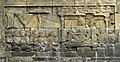 The scene of King and Queen with their subjects.
 -
 One relief on a corridor wall.
 -
 A weapon, probably the early form of keris.
 -
 A detailed carved relief stone.


Subscribe to:
Posts (Atom)