Sewu
Sewu is an 8th-century Buddhist temple located 800 meters north of
Prambanan in
Central Java. Candi Sewu is actually the second largest Buddhist Temple in Central Java after
Borobudur. Candi Sewu predates "
Loro Jonggrang".
Although originally only around 249 temples are present, the name in
Javanese translates to 'a thousand temples,' which originated from
popular local
folklore;
The Legend of Loro Jonggrang. The original name of this temple compound is probably
Manjusrigrha.
History

Sewu main temple before reconstruction.
Based on the
Kelurak inscription (dated from 782) and
Manjusrigrha inscription (dated from 792), which was found in 1960, the original name of the temple complex was probably
"Manjus'ri grha" (The House of Manjusri).
Manjusri is a
Boddhisatva in Buddhist teaching. Sewu Temple was probably built in the 8th century at the end of Rakai
Panangkaran administration. Rakai Panangkaran (746 – 784 AD) was a famous King from the
Medang Kingdom. The temple was probably expanded and completed during Rakai Pikatan's rule, a
Sanjaya dynasty prince whom married to a Buddhist princess of
Sailendra dynasty,
Pramodhawardhani.
Most of his subjects retained their old religion after the return of
Sanjaya dynasty. The proximity of the temple to Prambanan Temple, which
is a Hindu Temple, suggests that the Hindus and Buddhist lived in
harmony in the era that the temples were built. The scale of the temple
complex suggests Candi Sewu was a Royal Buddhist Temple and was an
important religious site of the past. The temple is located on the
Prambanan Plain, that is between the southern eastern slopes of
Merapi volcano and the Sewu mountain range in the south, near the present border of the
Yogyakarta province and
Klaten Regency,
in Central Java. The plain houses many archaeological sites scattered
only a few miles away, suggesting that this area was an important
religious, political, and urban center.
The temple was severely damaged during the
earthquake
in Java in 2006. The structural damage is significant and the central
temple suffered the worst. Large pieces of debris were scattered over
the ground and cracks between stone blocks were detected. To prevent the
central temple from collapse, the metal frame structures were erected
on four corners and attached to support the main temple. Although some
weeks later in 2006 the site were re-opened for visitors, the whole part
of main temple remains off-limits for safety reasons.
The temple complex

Aerial view of Sewu temple complex shows
Mandala pattern

The images of Boddhisattva on wall of perwara temple
The temple complex is the largest Buddhist compound in the Prambanan
area, with rectangular grounds that measure 185 meter north-south and
165 meter east-west. The entrance is found on all four cardinal points,
however judging from the layout of the temple complex, the main entrance
is located on the east side. Each of the entrances were guarded by twin
Dvarapala statues. This large guardian statues have been better preserved and replicas can be found at
Jogja Kraton. There are a total of 249 buildings in the complex arranged in a
Mandala
pattern around the central main hall as an expression of the view of
the universe of Mahayana Buddhism. The smaller temples are called
Perwara
(guardian) temples, consist of 240 temples with similar design and
arranged in four rectangular concentric rows. Two outer rows are
arranged closer and consists of 168 smaller temples, while two inner
rows are arranged in certain interval and consist of 72 temples than the
outer ones. The 249 temples that are located in the second precinct all
were made with a square frame but varied by different statues and
orientations. Many of these statues are now gone and the arrangements on
the current site are not in the original orientations. The statues are
comparable to the statues of
Borobudur and were likely made of bronze.
Along the north-south and east-west central axis at a distance of
about 200 meter, between 2nd and 3rd row of smaller temple are located
the
penjuru (main directions) or
perwara utama (main vanguard) temples, a couple on each cardinal points facing each other. The
perwara utama temples are the second largest ones after the main temple, however only eastern twin
perwara utama and a northern one still remains today. These smaller temples encompass a larger sanctuary that has been heavily looted.
Behind the 4th row of smaller temples lies the stone paved courtyard where the main temple stood on the center.
The main temple
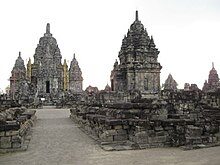
Candi Sewu main temple at left and one of
perwara temple at right
The main temple has a cross-like 20 corners polygon ground plan, with
29 meters in diameter and it soars up to 30 meters high. On each four
cardinal points of the main temple, are projected outward structures
each with its own stairs and entrances into each rooms and crowned with
stupas, thus forming a cross-like layout. All of the structures made of
the andesite stones. These four rooms are all connected with outer
corner galleries with balustrades. From the findings during the
reconstruction process, the original design of central sanctuary only
consisted of a central roomed temple surrounded by four additional
structures with open portals. In the next phase, doorways were later
constructed and narrowed to create door frames to attach wooden doors,
some of the holes to attach doors were still visible. The doorways join
the temples together into one main building with five rooms.
The central chamber can be reached from the eastern room. The central
chamber is larger than other rooms with a higher roof. Now all the five
rooms are empty.
. However the lotus carved stone padestal in central chamber suggested that the temple once contains a large
bronze Buddhist statue (possible the bronze statue of
Manjusri),
probably reaching 4 meters tall. Now the statue is missing, probably
being looted for scrap metal over centuries. However another theory
suggested that the main statue was probably constructed from several
stone blocks coated with
vajralepa plaster.


No comments:
Post a Comment